






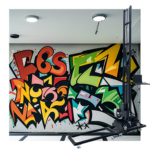
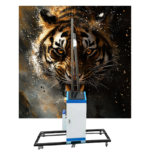
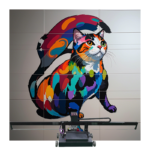
The Functionality of a 3D Floor and Wall Printer
What Is a 3D Floor and Wall Printer?
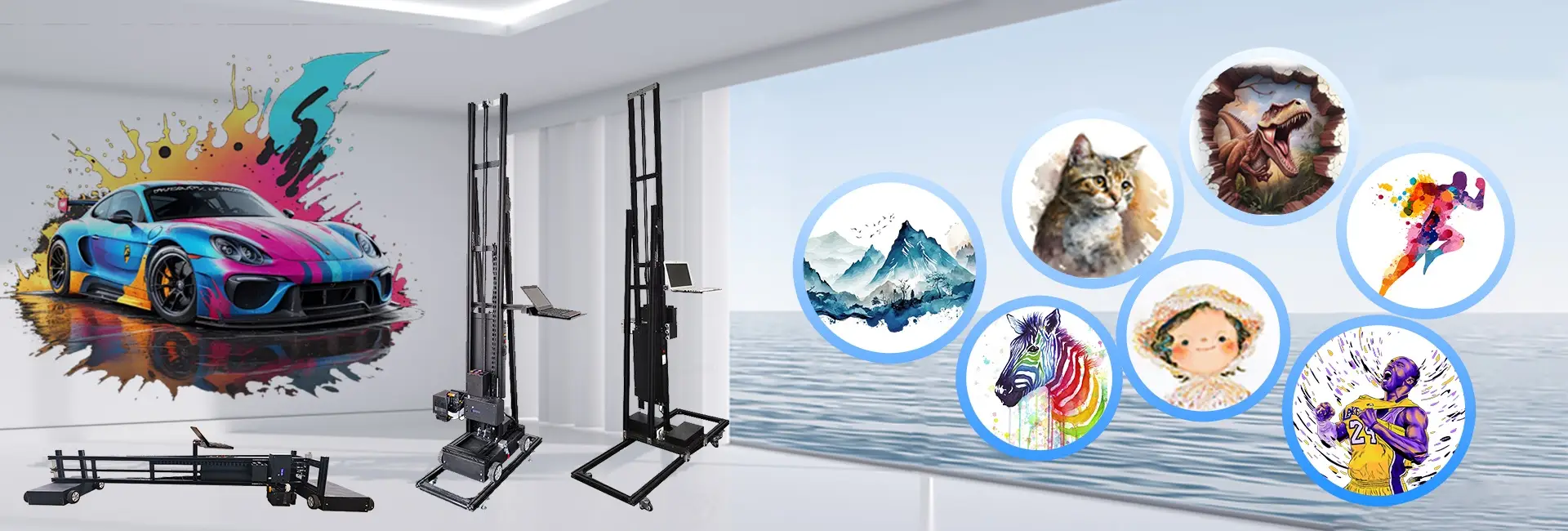
A 3D floor and wall printer is a special digital print device built to put bright, high-clear graphics right on up and flat surfaces. These machines are changing how murals, floor art, and brand visuals are made in home, business, and public spots.
Wall art printers use inks and smart control systems to make high-clear designs on surfaces. Our print quality can reach up to 2880 DPI, letting even complex patterns and real-life murals show with great sharpness.
This tech runs via advanced software that handles image work, line-up, and surface set, making sure art fits smooth into building shapes.
How Does the Print System Work?
The system behind a 3D floor and wall printer uses top inkjet tech. Using UV-cure or eco-solvent inks for lasting results, our printer sprays ink on the surface with exact nozzles.
The print head sits on a machine system that moves across three axes—X (side), Y (up-down), and Z (deep)—letting it change to different heights and surface shapes. Our laser positioning system and printheads’ electric lift ensures accurate image alignment. This makes sure the printed image stays right size and lined even on rough or slanted surfaces.
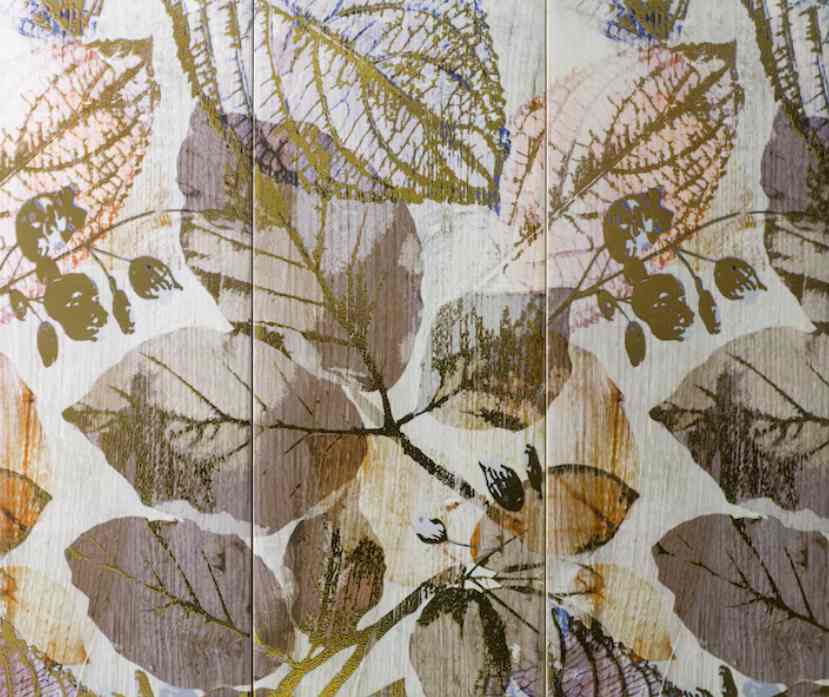
Fit to Hard Build Settings
What Problems Do Hard Build Settings Bring?
Construction sites, renovation zones, or irregular architectural interiors often introduce challenges such as uneven floors or walls, confined installation areas, and environmental factors like dust, temperature variation, or humidity. These variables can compromise print quality or make setup difficult for standard printing equipment.
How Do 3D Printers Beat These Problems?
Surface Check and Set
Modern 3D floor and wall printers are equipped with intelligent sensors. The printer is equipped with high precision ultrasonic sensor which can automatically detect the distance during printing. This allows the nozzle to maintain a consistent distance from the wall or floor, preventing distortion or ink bleeding caused by uneven surfaces.
Our wall printers use laser positioning and printheads’ electric lifting. This prints accurately on slightly uneven surfaces without warping—something hand painting struggles with. Such automated calibration minimizes manual adjustments, allowing for faster setup and greater accuracy.
Modular Build for Flex
Flexibility in design is critical when working in tight or awkward spaces. Our machines’ modular design allows heights up to 3 meters with unlimited width using extendable tracks. This modularity enables the printer to be installed in unconventional locations with minimal repositioning.
To accommodate tall walls or multi-story prints, printers also include vertical lift systems. These can be adjusted on-site depending on the project’s specific height requirements.
Software Fit for Setting Limits
Software plays a crucial role in adapting to build site limitations. The printing software now supports English, Russian, German, French, Portuguese and Spanish. Additionally, intelligent control systems compensate for angular deviations and curvature by recalibrating image layout in real-time.
Operators can customize settings related to ink flow rate, printing resolution, and alignment directly via control panels or connected tablets, making adjustments based on environmental feedback and desired output quality.
Materials and Surfaces That Work with 3D Floor and Wall Printers
Which Surfaces Can Be Printed On?
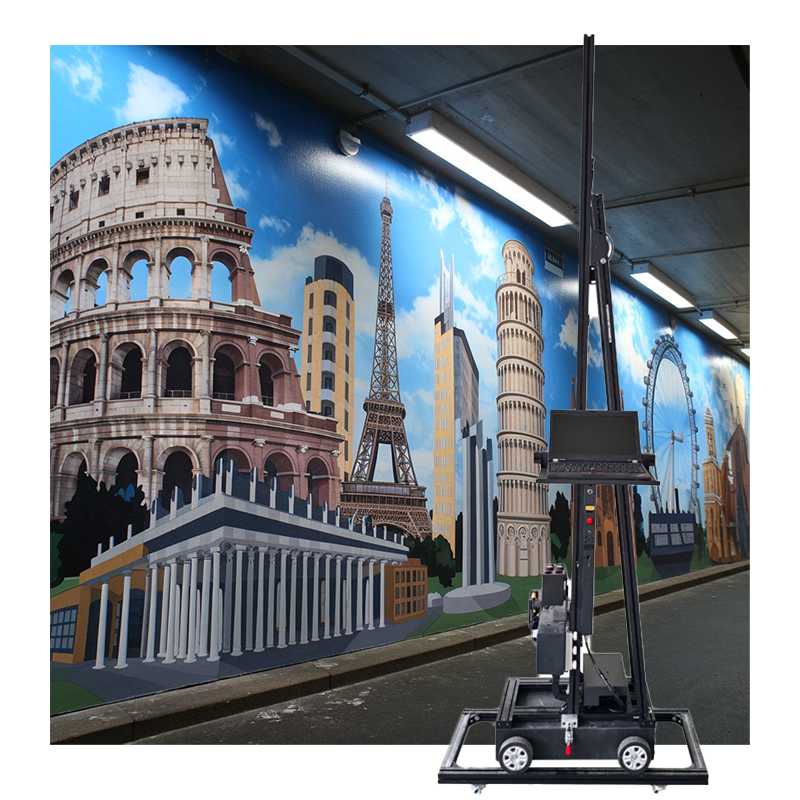
One of the major advantages of 3D floor and wall printers is their compatibility with diverse materials. Thus plaster, wallpaper, wood, brick, latex paint, stone, clinker, plastic, metal, glass, most tiles and many other materials can be printed without any problems.
Porous surfaces like drywall or concrete may require different primer treatments compared to nonporous ones like glass or tile. However, the printer’s ability to adapt ink type ensures strong adhesion across most substrates.
What Kinds of Inks Are Used in These Printers?
UV-Cure Inks
UV inks are widely used due to their fast drying time and superior durability. UV-curable ink used in machine-printed murals cures instantly under UV light. It cures immediately after printing, forming a film with excellent coverage.
UV inks make prints waterproof, fade-resistant and durable and can last outdoor 3-5 years and indoor 15-20 years. This makes them ideal for both interior murals and exterior advertising graphics.
Eco-Solvent Inks
Eco-solvent inks offer an alternative for indoor applications where environmental safety is a concern. UV ink is a solvent-free ink that does not contain a large amount of volatile organic compounds (VOCs) like traditional solvent-based inks, so it is less harmful to air pollution and human health.
These inks are especially effective on smooth indoor surfaces like vinyl panels or laminated boards where minimal odor and quick drying are essential.
Work Flow of a 3D Print Job in Build Sites
How Is a Print Job Set from Start to End?
Image Set and File Change
Graphics begin in design software. Firstly, import the picture into Photoshop. Click on the “image” tab, then click on “mode” and convert the color to CMYK color These files are then converted into TIFF format before being processed by RIP software like UltraPrint. Secondly, input the adjusted TIFF format file into the RIP software(Name: ultraprint) Finally, BetterPrinter software is used for final execution on the machine.
On-Site Setup Steps
Upon arrival at the job site, the printer is assembled using modular rails. Quick assembly: Equipped with movable pulleys and self-supporting slide rails, which can be assembled quickly.
Calibration begins with laser levels or built-in sensors to ensure precise alignment before starting the print.
Live Watch During Print
During operation, technicians monitor key parameters such as ink flow rate and nozzle status using an integrated interface. Our low Ink Alert System notifies you when ink levels are low, ensuring continuous, high-quality prints.
If any issues arise—such as misalignment or nozzle clogs—the system automatically pauses printing for correction.
Meet Hanjie’s Wall and Floor Printer Tech
Who Is Hanjie and What Makes Their Tech Stand Out?
At Hanjie, we specialize in cutting-edge wall and floor printing solutions designed for versatility across complex architectural environments. Our range of HJ series printers caters to both creative professionals and industrial users.
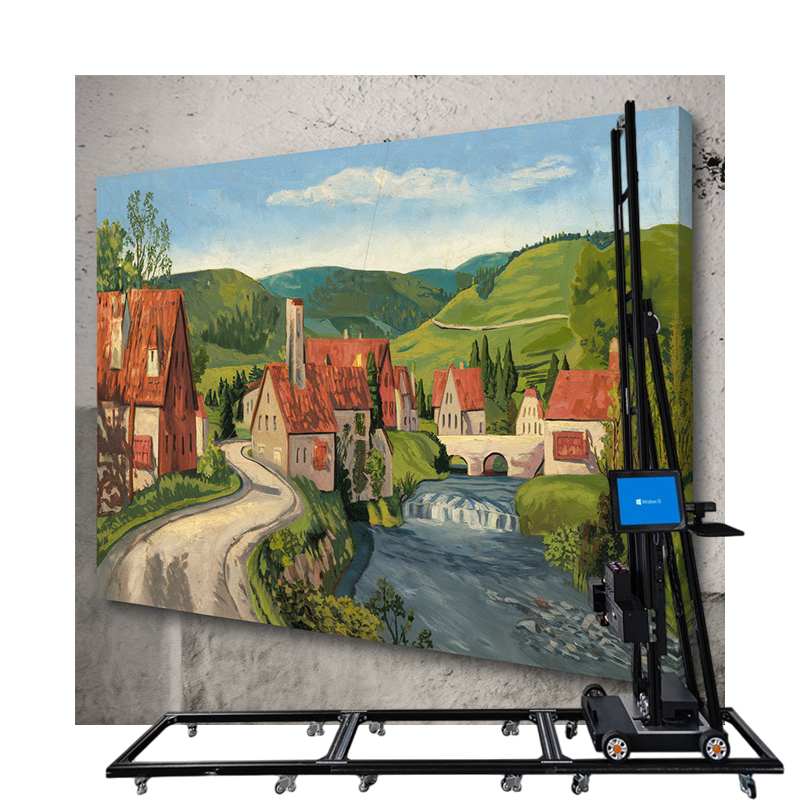
Our HJ-426 model is a standout performer for those seeking both vertical and horizontal printing capabilities in one device. A revolutionary all-in-one solution that delivers the power of two machines for the price of one.
What Are the Key Traits of Hanjie’s Wall and Floor Printer?
Exact Build for Hard Projects
With a maximum resolution of 2880 DPI and customizable height up to four meters, our printer ensures professional-grade output. Powered by a precision EPSON printhead (DX10, or I1600), the HJ-426 achieves an industry-leading 2880 DPI.
Fully automatic with auto-calibration, surface detection, and height adjustment makes it suitable for intricate designs on curved or non-standard surfaces.
User-Easy Software Link
Our interface supports drag-and-drop image placement via tablet or laptop. Tablet with Wi-Fi: Wi-Fi connected tablet allows remote operation for convenient monitoring from anywhere on site.
Strength and Ink Fit
HJ-426 supports both UV-curable inks for outdoor use and eco-solvent inks for indoor projects. Supports both UV-curable inks for permanent outdoor murals and eco-solvent options for indoor décor.
Its robust build handles prolonged exposure to construction environments without performance degradation.
FAQ
Q: Can a 3D wall printer work on textured or uneven walls?
A: Yes, there is a leveling system on the printhead controller that compensates for unevenness of the floor constantly adjust the distance between the printhead and the wall to keep it constant.
Q: How long does it take to print a full-size mural on a wall?
A: The printing speed of the wall printer is 6~14 square meters per hour Therefore, most murals can be completed within 2–6 hours depending on size and complexity.
Q: Is special maintenance required after each use of a floor/wall printer?
A: Routine maintenance includes cleaning printheads, checking ink levels, inspecting sensor calibration This usually takes less than 30 minutes per session.
Q: What should I do if the printed image is blurry?
A: Check that the print head is 3-5mm away from the wall and recalibrate the laser positioning.
Q: Can your printer machines print floor graphics that resist foot traffic?
A: Yes. After floor printing is complete, we recommend applying a layer of clear protective varnish This protects against scratches, moisture, and wear.
Q: How does your after-sales service work for floor and wall printers?
A: We provide one-year warranty service Permanent online one-to-one engineer guidance and training are also included to ensure optimal performance throughout usage.